
An AI pilot for chest x-rays in Glasgow helped clinical staff redesign the pathway for patients – leading to quicker follow-ups and a more efficient process, according to a senior NHS leader.
Clinical trials which saw artificial intelligence integrated into lung cancer screening across NHS Greater Glasgow & Clyde also led to an improved service model, with faster contact for patients needing subsequent CT scans.
Katriona Brooksbank, regional head of innovation for the health board, pointed to the benefits of not only the technology itself – which can help flag x-rays of concern – but also how it prompted clinicians to reconsider the way care was delivered.
Brooksbank, speaking at the annual DataFest event in Edinburgh yesterday, said: “We wanted to make sure that the clinicians reviewed those with the most clinical need first, not in order of presentation, but at the same time we changed the way that anyone who was identified with an early suspicion of lung cancer then had the next step in the diagnostic pathway.”
“Instead of writing to a GP to say [a patient] has this early suspicion, we need to order a CT scan, which could take a couple of weeks, we got the outpatient staff to phone the patients and say AI has flagged, a human has reviewed it, we now need a CT scan. Some people got the CT scans the same day, not weeks later.”
She added: “So, it was a combination of a tool, a change in workflow prioritisation for our clinicians, and then the different structure for the whole service to be able to shorten that pathway. And actually it makes sense to do it at the same time, because we’re adding in a new technology that a lot of our workforce and patients are unfamiliar with. If we’re going to go to the effort to try and educate and ensure people feel that it’s trustworthy, the tool we’re using, we may as well look at the process as well.”
The trials were a collaboration between NHS Greater Glasgow and Clyde, the West of Scotland Innovation Hub, the University of Glasgow, and Ai company Qure.ai. Known as the the RADICAL (Radiograph Accelerated Detection and Identification of Cancer of the Lung) study, the trials were conducted over 24-months and evaluated 87,000 chest x-rays.
However, despite ‘proven feasibility’ of integrating the AI tool into clinical workflows, the health board has yet to adopt the technology at scale.
“The reality is that although we’ve generated lots of evidence, published peer-reviewed journals about the potential for clinical AI solutions, we haven’t yet implemented any at scale, and that is because of infrastructure and organisational challenges,” added Brooksbank.
She said another learning point from the study had been that although the health board had spent time educating clinicians and patients about AI, it had not spent enough time educating administrative staff who may be asked questions about the technology.
“That was our failing, and we learned from that,” said Brooksbank. “So, actually, as an organisation, we’re now looking at what our different levels of AI literacy need to be if we’re going to implement and scale in the public sector, and that needs to be everybody in our organisation. For someone wheeling you along the corridor, you may ask them a question about something that’s being used in your care pathway, and we as an NHS would like the response to be positive.”
Other bureucratic challenges included having 14 regional health boards to coordinate when it comes to scaling technology nationally, and the need for firm leadership to ‘steer’ everyone in the right direction.
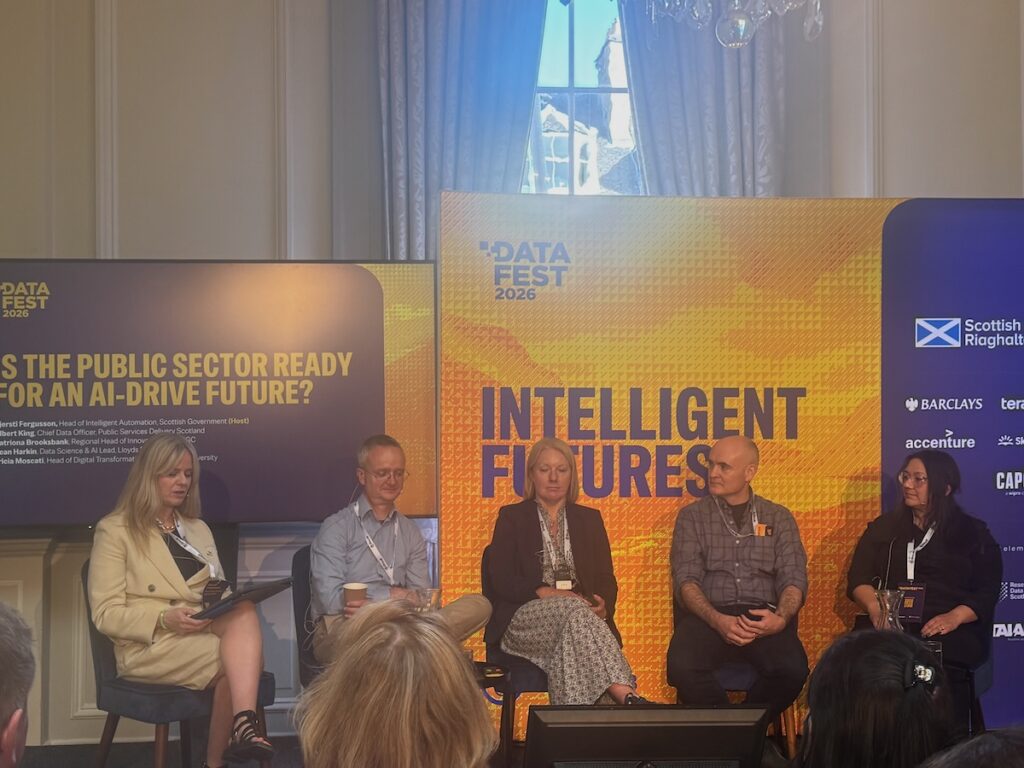
Brooksbank was taking part in a panel discussion – is the public sector ready for an ai-driven future? – at the industry event at Edinburgh’s Assembly Rooms. Bureaucratic challenges to adoption were highlighted by most panelists, who include Albert King, chief data officer at Public Services Delivery Scotland, Sean Harkin, data science and AI lead at Lloyds Banking Group and Tricia Moscati, head of digital transformation at Heriot-Watt university.
The panel – chaired by Kjersti Fergusson, head of intelligent automation at the Scottish Government – agreed that the danger of introducing any new technology, such as AI, risked optimising current business processes, rather than harnessing its potential to redesign the way services are delivered.
Albert King said: “You can sprinkle a little bit of AI into an existing workflow process, and maybe take out 15% of the time required out of that process, in much the same way that you could do something online or create an electronic form or something.
“But the really difficult thing to do…. are those service transformation redesign pieces, and they require leadership and vision to accept the need for service transformation.”