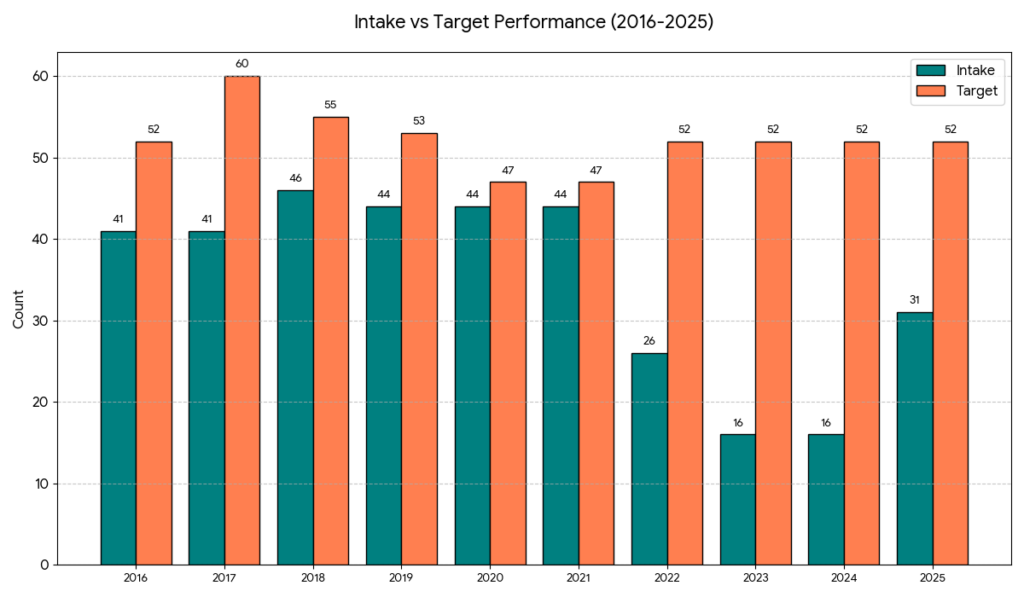
A new government report has revealed the biggest increase in computing science teacher annual recruitment numbers in Scotland since records began.
Halting a long-term decline, the Computing Science Summary Report released by the Scottish Government this week, shows the number of computing science teachers recruited into the profession almost doubled last year.
Although recruitment numbers are still below target, and the subject has a lower overall number of teachers than at any point since 2008, 2025 was the first year to see a significant rise since recruitment numbers began to be publicly recorded in 2016. The only other year where an increase was recorded was 2018 when numbers rose from 41 to 46 [see table below].
According to the statistics, there were 31 computing science teachers recruited last year, compared to 16 in both of the previous academic years.
Whilst it fell short of the ‘Initial Teacher Education’ (ITE) target of 52, proposed by the government’s Teacher Workforce Planning Advisory Group, computing science teaching campaigner Toni Scullion hailed the result.
Describing the uptick in numbers as “amazing”, she also credited the government report for revealing the “important” role the subject has in Scotland’s future ambitions to be a world-leading technology economy.
And she paid tribute to the teacher-led network ‘STACS’, set up in response to Mark Logan’s Scottish Technology Ecosystem Review, which has been working over the last few years to promote the subject as a career option.
She said: “STACS has actively being going out to universities and colleges, attending careers fairs and doing talks to students, raising awareness of computing science teaching and teacher training courses. This has also involved us working with computing science teachers and getting them involved as well which has been great.”
“Then, we’ve also been leading a computing science teacher ‘insight’ opportunity. That basically means for any individual interested in becoming a computing science teacher and want to know what it’s like, we match them to a school who is able to host them for 1 or 2 days to let them see what it’s like. All PGDE [Professional Graduate Diploma in Education] courses require school experience so we are helping with that but also computing science teaching is one of those jobs where you’ve got to be in a classroom to see if you like it or not.”
The report does not shy away from some of the challenges for the subject in schools, particularly when it comes to pupil equity and access, an ongoing gender disparity in the subject, and resources.
The report says: “Access to digital resources, and in particular, access to software to support the teaching of Computing Science was mentioned during the meeting series as a particular challenge facing the subject. We know that local authorities take different approaches to facilitating school access to digital resources including software, in line with their individual IT policies.
However, we heard that access, or lack of it, to a range of software inhibits the learning and teaching of the subject. During the meeting series we heard the view that this was perhaps becoming a greater issue in schools.”
Scullion acknowledged those problems were “harder and slower to change”, but she also credited a braided careers initiative, hosted by the likes of the University of Glasgow, which encourages tech sector workers to double up as computing science teachers.
Firms like Skyscanner, the technology travel giant, have taken part in the scheme, and although the cohort numbers have been relatively small, Scullion added “every little helps”.
Notwithstanding teacher recruitment for the subject, the report also outlines how between 2019 and 2025, entries to National 5 Computing Science have increased by 3.8%, while entries to Higher have increased by 22.6%, showing a positive upward trend at pupil level.
The report added: “Encouragingly, there has also been an increase in the number of female entries to Computing Science National Courses in the same period, by 12.9% at National 5, 53.3% at Higher, and 72.2% at Advanced higher.”
Scottish Teachers Advancing Computing Science (STACS) is a teacher-led organisation aimed at supporting teachers delivering Computing Science in Scotland. It has been operating for five years and is government-funded until March 2027.
Despite the progress, historically, teacher numbers for computing science have never been lower in Scotland. According to the report, there were 550 computing science teachers in Scottish high schools in 2024/25, compared to 766 in 2008/09.