
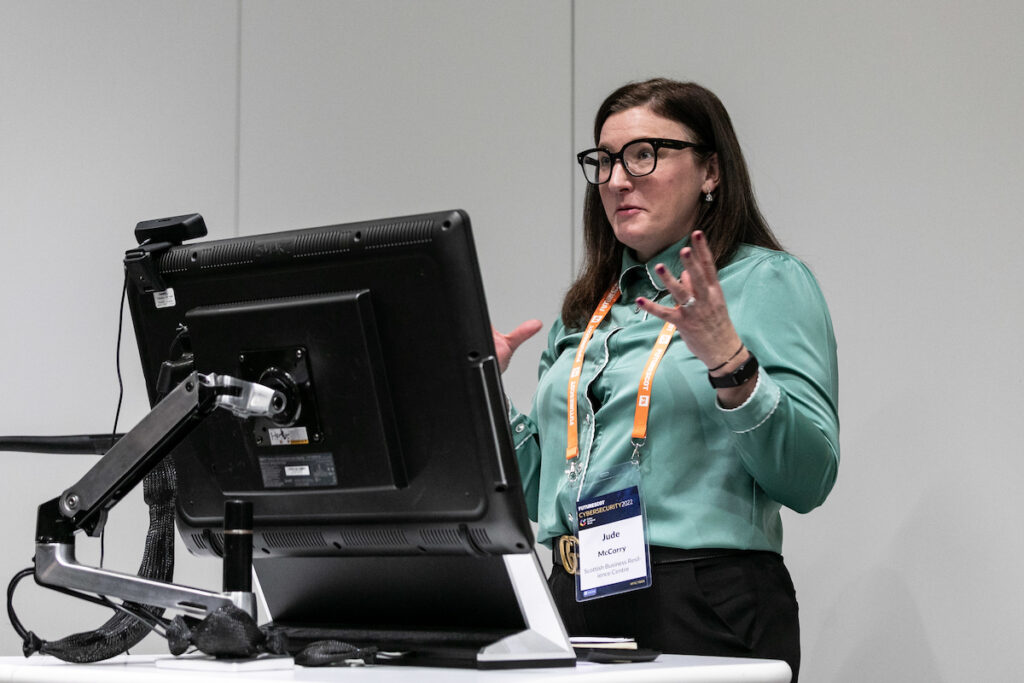
Jude McCorry is to step down as chief executive of the Cyber and Fraud Centre Scotland after almost seven years at the helm.
McCorry, who took charge of the organisation – then the Scottish Business Resilience Centre (SBRC) – in 2020, will remain in post until February 2027 to oversee a smooth handover. The search for her successor is already underway.
Announcing her decision, McCorry recalled that she started in the role, her first as a chief executive, in the very week the country went into lockdown. Despite the uncertain start, she described the years since as “the privilege of my career”.
Sharing the news on LinkedIn today, she said: “After nearly seven incredible years, I’ve made the decision to step down as [CEO of] Cyber and Fraud Centre Scotland.
“I started this role, my first ever as a CEO, the very week the country went into lockdown. I had no idea what lay ahead, but from that uncertain beginning, it has been the privilege of my career. This hasn’t been an easy decision. I’ve never stayed in a role beyond five years, but when that milestone came around, I knew there was more we could do, so we kept going.”
She said the centre was now in its strongest position yet, saying it is ‘fully self-sustaining with no reliance on government funding, backed by growth investment from Social Investment Scotland’, and at the start of a new data and AI programme with a number of partners.
But McCorry said it was the people she was proudest of, describing a “small but mighty” team that works with “flair, passion and compassion”.
Under her leadership, the centre has become a first port of call for Scottish organisations hit by cyber attacks, advising the likes of Arnold Clark, Comhairle nan Eilean Siar (Western Isles Council) and the Scottish Environment Protection Agency (SEPA) in the aftermath of significant incidents.
The centre helps public bodies and private companies both respond to attacks and strengthen their defences. It became a social enterprise last year, having previously operated as a not-for-profit organisation.
McCorry’s departure comes shortly after a change at the top of the board. Last month Willie Fairhurst was appointed chair, succeeding Paul Atkinson, who stepped down after more than five years in the role. Atkinson became chair of the then SBRC in 2021 and guided the organisation through its rebrand as the Cyber and Fraud Centre – Scotland and its move to social enterprise status.
McCorry joined from The Data Lab, Scotland’s innovation centre for data and AI, where she was business development director. She had earlier set up Edinburgh Napier University’s commercialisation arm, The Edinburgh Institute.
Shortly after taking up the role she was appointed the first chair of the CyberScotland Partnership steering group, which brings together organisations working towards a cyber-resilient Scotland.
She has also been an outspoken advocate for better support for victims of cybercrime, including urging security vendors not to bombard organisations with sales approaches in the immediate aftermath of an attack, and led the centre’s move to a four-day working week, trialled from April 2022.