

A new Futurescot survey of 130 public sector staff finds AI tools in everyday use across Scotland’s public services. But trust averages 4.5 out of 10, the rules are full of grey areas, and many doubt anyone at the top has worked out what AI is for
Public servants in Scotland are using AI at work in large numbers, but they are far from sure they can trust it, according to a new Futurescot survey.
Three-quarters of respondents use their organisation’s approved AI tools, and more than half use them every week, yet they rate their trust in the technology at just 4.5 out of 10 on average.
Their reservations run deep. Nearly nine in ten worry about AI’s tendency to ‘make things up’, and two-thirds worry about its environmental footprint. Almost three-quarters are not confident that today’s regulatory framework can manage the technology responsibly.
That gap between use and trust is the defining finding of our survey. We heard from 130 staff across Scotland’s public sector, spanning core Scottish Government directorates and agencies, local authorities, NHS boards, the emergency services, education and the third sector.
Across 63 questions covering knowledge, use, trust, regulation, skills and culture, adoption, sovereignty and the outlook for the next decade, they told us how they use AI, what holds them back, what they fear, and what they want from their leaders and from government.
The result is a snapshot of a workforce that is neither starry-eyed nor Luddite.
People seem to be balancing competing instincts of pragmatism and scepticism, and at points in the survey come across as deeply uneasy.
Staff are willing to let AI draft a letter but far less willing to let it wield power over a decision about someone’s benefits or care.
They want clearer rules, better training, more honesty from politicians about the risks and limits of AI and more control over where public data goes.
“I do not ‘trust’ the models,” one NHS digital specialist told us. “That’s not to say that they are not useful.”
Copilot country
If AI has arrived in Scotland’s public sector, it is mostly in the form of Microsoft Copilot. Of the 98 respondents who use sanctioned AI tools, 94 said they use the platform. No other product even came close.
Among those users, ChatGPT Enterprise was named by 10, Google Gemini by seven and Claude by four. Specialist, sector-specific and in-house tools barely registered among respondents.
That is largely a story about procurement, licensing and, one could argue, an overly-dependent reliance on one of the world’s largest technology companies.
Copilot comes with the Microsoft 365 estate that many public bodies already run, and several respondents said it is permitted because it keeps data inside their organisation’s ‘protected environment’.
“All AI tools apart from Copilot are blocked on work devices,” said one agency specialist. “Most AI platforms are so blocked that we can’t even read about them to assess costs or options,” said a Scottish Government staffer. “Getting approval (cybersecurity) is a painful, drawn out process.”
In all, 52 per cent of respondents said they use sanctioned tools ‘weekly or more’ and a further 23 per cent ‘occasionally’.
Not everyone with access uses it, however, according to our findings. Some 15 per cent, or 20 respondents, have sanctioned tools available to them but choose not to use them, and they include the survey’s most avowed sceptics. Their average trust in AI is a mere 1.7 out of 10, against 4.5 overall, and 16 of them said AI is either largely hype or that its risks outweigh its benefits.
It is a small group, but a significant one, and arguably shows that giving staff access to AI is not the same as winning them over. If AI is to be adopted widely across the public sector, as the current direction of travel suggests in Scotland, it’s worth asking whether these staff will simply fall into line or push back against the government’s reform agenda.
At the other end of the scale are the enthusiasts who look beyond approved platforms. Some 21 per cent freely admit to using personal, non-sanctioned AI tools for work at least occasionally, rising to 26 per cent among weekly users.
“A blanket ban isn’t very realistic,” said one respondent who occasionally uses a personal AI subscription for work queries.
A local authority manager said their policy was largely followed, “although I and others do use ChatGPT or Claude for more generic research or wording, as these tools are more effective for these tasks”.
Clear rules do not stop staff using unapproved tools, however. Among respondents who say their organisation’s AI rules are clear and well communicated, almost one in five owned up to still using unsanctioned tools, potentially in breach of those very rules.
One respondent in education put it bluntly: “Policy says ‘don’t do stuff that hasn’t been approved’, and everyone does stuff that hasn’t been approved.”
The trust deficit


Trust in AI averages 4.5 out of 10, and our respondents were practically split down the middle. Some 44 per cent scored their trust at four or below, while 42 per cent scored six or above. Only nine people out of 130 scored eight or above, and just one said they broadly trust AI.
People’s main worries centred on accuracy. Almost nine in ten respondents (89 per cent) distrust AI’s tendency to “hallucinate”, or confidently make things up.
“I often find myself spending a lot of time refining prompts and requests, only to end up completing the task myself,” said one specialist at a public body.
Another said: “Putting the responsibility on the user to check the results removes a great deal of the point of AI.”
The survey ran as Scotland’s datacentre debate was heating up. More than 20 large facilities have been proposed across the country, including one at Auchtertool in Fife that its developers say could become the second-largest in the world.
At full capacity, its expected electricity use would equal around 7.7 per cent of all the power Scotland generated in 2024.
Concerns about grid capacity, water use and the impact on local communities have grown. In August, ministers required councils to notify them of any proposed datacentre above 50 megawatts.
In September, as hundreds of protesters gathered at Holyrood, MSPs rejected a Scottish Greens’ call for a moratorium, but backed a non-binding call for no planning decisions to be taken until national guidance is in place.
Ministers have promised that guidance before Christmas, and have made environmental impact assessments mandatory for these larger developments, to strengthen safeguards around energy and water use.
Weeks later, plans were lodged for a £16.5 billion, one-gigawatt datacentre campus at the former Chapelcross nuclear site near Annan, which drew more than 1,000 objections within 48 hours. Two Holyrood committees are now gathering evidence on the impacts of hyperscale datacentres.
Our respondents shared many of those concerns. Two-thirds (67 per cent) cited AI’s environmental impact as a reason for distrust, level with confidentiality of organisational data (66 per cent) and ahead of privacy of personal data (62 per cent), bias (61 per cent) and data sovereignty (60 per cent).
“We have declared a climate emergency as an organisation, so how can we use AI?” asked one local authority worker. Some respondents linked this directly to datacentre development in Scotland.
Councils, in particular, are being pulled in both directions, encouraged to adopt AI while also deciding whether to approve the datacentres that power it.
Suspicion of who builds the technology was also a factor among respondents. Some 61 per cent said they distrusted “the motives of the companies building AI”, with one council manager saying their trust would only rise if AI “wasn’t produced by large, mostly American, corporations who put profit before producing a good product”.
People were clear about what AI is good for. Eight in ten (82 per cent) trust it to process large volumes of information quickly. Around two-thirds trust it to spot patterns humans would miss (65 per cent) and to free up staff for higher-value work (65 per cent). Just one in five think it avoids human biases such as favouritism, while nearly one in ten don’t trust it to do anything reliably.
Asked what would increase their trust, respondents’ answers ranged widely, from transparency about how AI works and where data goes, to hard evidence that it delivers.
“More examples of it actually working well,” wrote one senior manager, who added: “In my personal and professional experience I see many examples where documents created using AI deliver content that is erroneous and simply wrong.”
“Organisations seem to keep quiet when testing,” said another.
A couple argued some distrust is healthy. “I think a bit of mistrust is the right way to approach AI,” one agency manager said, “ie always check the outputs.”
Trust and usage also go together, the survey showed. Weekly users rated their trust at 5.4 on average, compared with 4.3 among occasional users.
Meanwhile, 70 per cent of those who scored their trust at six or above were optimistic about AI-enabled public services, against just 18 per cent of those at four or below.
The experts are the sceptics
The most sceptical people about AI in our survey were those closest to the technology. Digital, data and IT professionals, who made up 45 per cent of respondents, gave the lowest average trust score of any professional group: 4.0, compared with 5.1 among policy and strategy staff.
That finding chimes somewhat with recent media coverage of current and former researchers working inside the AI labs themselves, several of whom have spoken out about the rapid advance of frontier models, and the potentially existential dangers it poses.
More than a third of digital, data and IT respondents (36 per cent) also said AI is either largely hype or that its risks outweigh its benefits, against 17 per cent of those in other roles.
Those who rated their own understanding of AI highly, at eight or above, trusted it no more than those in the middle, with an average of 4.5, against 4.8. Knowing more about how these systems work does not, it seems, make people more comfortable with them.
Among digital, data and IT staff, criticisms of AI range from outright rejection to detailed technical objections. Several distinguish sharply between generative and other kinds of platforms.
One NHS digital manager suggested “specifically focusing on AI tools that are not generative LLMs”, giving “pattern spotting tools for diagnostic imaging” as an example.
A senior NHS digital leader called for “a measured approach to implementation and less driven by sales pressures from hyperscalers who have bet the farm on AI”.
Digital, data and IT staff are the people who will implement, secure and maintain AI services, and a lack of skills to run AI was already the second most-cited barrier to adoption in our survey (42 per cent).
Yet nine of the ten chief executives and directors who responded think their organisation’s appetite for AI risk is about right.
If those closest to delivery remain the least convinced, enthusiasm at the top will not be enough, and leaders may need to answer their objections rather than manage them.
Rules with grey areas
Most respondents said their organisation now has AI rules of some kind. About half (49 per cent) said those rules were clear and well communicated, but almost a third (30 per cent) said they were unclear or poorly communicated. A further 11 per cent know of no formal rules at all.
Asked whether they understand what they are legally allowed to do with AI in their role, only 32 per cent said “yes, clearly”. Almost half (47 per cent) said “roughly, but there are grey areas”.
One respondent described policy documents on AI that are “not easy to follow”, which “creates overcautious behaviour in colleagues and they are not utilising AI to its fullest”.
Clear rules on data protection are obviously necessary, but they have an unintended consequence.
In services built around personal data, they limit how far AI can be used at all, with some organisations banning staff outright from putting personal data into AI tools. “As the bulk of our work involves customer personal data, some colleagues feel this limits their ability to use AI at all,” said one agency staffer.
Getting AI policies agreed also can take a long time, according to one respondent. The local authority worker described “two years of back and forth” between senior management and committees before the council agreed to set up a data ethics board to approve every AI use case.
Asked what most limits their use of AI at work, respondents put the quality and reliability of outputs first (45 per cent). Concerns about data protection came next (43 per cent), then time to learn and experiment (38 per cent).
Lack of skills or confidence followed (28 per cent). Lack of access (15 per cent), unclear permission (14 per cent) and disapproval from colleagues (10 per cent) were less common. Only 15 per cent said nothing holds them back.
Where AI touches sensitive decisions, respondents were clear about the safeguards they want
Human in the loop is non-negotiable

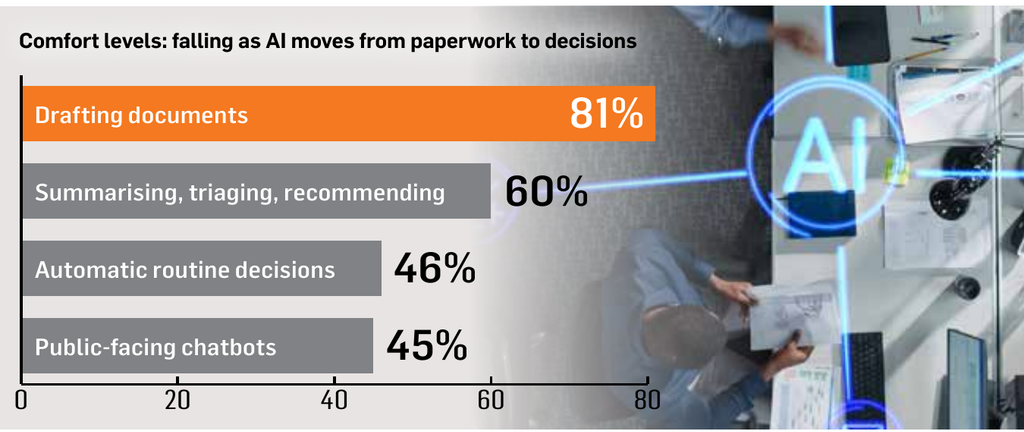
Comfort with AI falls steeply as its role moves from paperwork towards decisions and dealing with the public.
Some 81 per cent are comfortable with AI drafting documents and correspondence, but that dropped to around 60 per cent for summarising case files for a human decision-maker, triaging cases, or recommending a decision that a human then approves.
When it came to AI making routine decisions automatically, such as renewing a licence or permit, with people overseeing the system rather than each case, fewer than half of respondents (46 per cent) were either ‘very’ or ‘fairly’ comfortable, with almost as many (45 per cent) uncomfortable or strongly opposed. It also drew the strongest outright opposition of any use: more than one in five (22 per cent) were strongly opposed.
AI dealing directly with the public, through chatbots, divides opinion in much the same way. Only 45 per cent are comfortable with it, and 16 per cent are strongly opposed.
For many respondents, this was not an abstract question. Nearly two-thirds said their own role involved sensitive data or decisions, directly or indirectly, in areas such as health records, child protection, criminal justice and benefits. Where AI touches sensitive decisions, they were clear about the safeguards they want.
The top requirement, chosen by 86 per cent, was that a human always makes or approves the final decision. “There must ALWAYS be a human in the loop!” one senior agency manager wrote.
Next came regular independent audit of accuracy and outcomes (79 per cent), testing and monitoring for bias (78 per cent) and staff trained to challenge and override the system (78 per cent).
Around three-quarters also want people told when AI has been involved in a decision about them, with decisions that are explainable in plain language, and a clear right of appeal to a human.
Public consultation before AI is used in sensitive settings drew much less support, at 38 per cent, suggesting staff put more faith in technical and managerial safeguards than in public consent. A small minority (12 per cent) said no safeguards would be enough, and that AI should not be used in such decisions at all.
The view from the top
Most respondents said their leaders back AI, but often more in word than in deed. Some 38 per cent say their leaders are positive about AI “visibly and consistently”. Another 35 per cent describe “supportive words but limited action”, and 15 per cent say their leaders are silent on the subject.
Respondents describe the prevailing culture towards AI in their organisation as “cautiously positive” (48 per cent) or “ambivalent” (24 per cent), and its appetite to adopt AI as strong (38 per cent) or moderate (35 per cent).
Where there is resistance, respondents attributed it to concern about quality and errors in public services (59 per cent) and ethical concerns (57 per cent) more than fear of job losses (39 per cent).
What many asked for was simple: leaders who use AI themselves and talk honestly about it
Where leaders and managers parted company, though, was over how much risk their organisations should be willing to take with AI. Nine of the ten chief executives and directors who responded thought their organisation’s appetite for AI risk was “about right”.
Among the 44 middle managers and team leaders, only 12 agreed. Nineteen thought their organisation was too risk-averse, and ten thought it was not cautious enough or even “recklessly gung-ho”.
In short, leaders themselves seemed content with where their organisations stand; middle managers are far less sure. There are only ten senior respondents, but the gap is striking.
Some respondents wanted bolder leadership: “Be brave. Encourage its use. Be less risk averse.” Others felt pressure to use tools for the sake of it. “It was expensive to procure, so now there’s a bit of pressure from leaders to show that it’s being used,” said one agency specialist, “meaning people are being encouraged to use it for pointless tasks to make the figures look good.”
Another reported that their chief executive had described Copilot as “1,000 new colleagues”.
What many asked for was simple: leaders who use AI themselves and talk honestly about it. “You can’t be what you can’t see,” one senior manager wrote.
Respondents also recognised the familiar problem of pilots that never become services, with only 8 per cent reporting their organisation as having adopted AI effectively.
Some 21 per cent recognise a pattern of “lots of pilots, little lasting adoption”, and 38 per cent said only some pilots make it into everyday use.
The barrier chosen most often was funding, because pilots are funded and ongoing services are not (47 per cent). Next came a lack of skills to run and maintain AI in production (42 per cent) and governance and approval processes (35 per cent).
“Often the pilot shows something can be done, but the economics don’t then work out,” one agency manager explained. A council manager noted that “sometimes the landscape has changed by the time a pilot has been completed.”
One sceptic offered a different explanation: “Pilots so far have only highlighted the unsuitability of tested AI. Either sub-standard or hallucinating,” they wrote. Yet “there are always more pilots as corporate are desperate to make it work… so they can get on with saving money by making some roles obsolete.”
Personal agency is limited too. Only 29 per cent felt they could both explore AI and adopt it. A further 42 per cent could ‘explore/trial’ AI, but adoption decisions sat elsewhere, and 15 per cent didn’t know what they were empowered to do.
The sovereignty question

Some of the strongest agreement in the survey was over who controls the technology. Some 74 per cent were “very concerned” about dependence on a small number of mostly US technology companies, and only four respondents (3 per cent) said they were not very or not at all concerned. Almost as many were very concerned about security threats from AI-enabled fraud, disinformation and cyberattacks (72 per cent).
Concern was similar for national resilience if critical services came to rely on AI we do not control (69 per cent). Around half were very concerned about public data being processed under foreign jurisdictions (52 per cent) and about losing the in-house skills needed to scrutinise what suppliers provide (50 per cent).
Paradoxically, the same workforce that is anxious about dependence on US tech giants relies overwhelmingly on Copilot, a US product.
Of the 96 respondents very concerned about that dependence, 65 use it at work. And of the 60 per cent who distrust AI on data sovereignty, only a third said they could confidently tell AI hosted in the UK or EU from AI hosted elsewhere.
Some 65 per cent of respondents said Scotland or the UK should invest in sovereign AI capability, such as domestically hosted models and public compute, as “a strategic necessity”.
A further 15 per cent would do so for the most sensitive uses only, and just 6 per cent would rely on the best global tools with safeguards. “A national platform that means we are not leaking our data to American organisations,” was one director’s request. Nearly half (48 per cent) said it was essential that public sector AI adoption also supported Scotland’s own AI economy.
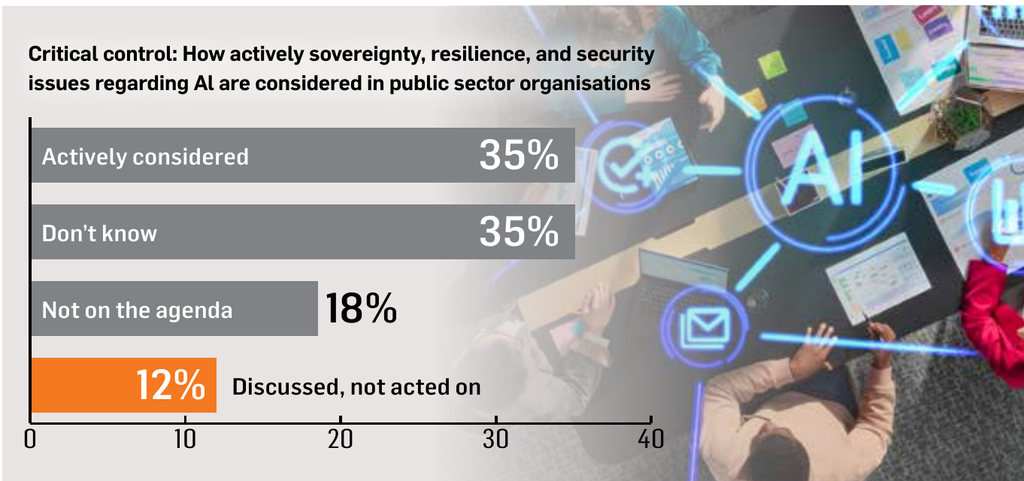
But these concerns have not yet reached most organisations’ agendas. Only 35 per cent said sovereignty, resilience and security were being actively considered where they work. Another 35 per cent didn’t know, 18 per cent said the issues were not on the agenda, and 12 per cent said they had been discussed but not acted on.
Confidence in commercial deals is also weak. Only 13 per cent were fairly confident that procurement got good value and fair terms from AI suppliers, and 53 per cent were not confident. On the pace of procurement, views diverged: 27 per cent thought it was too slow, 17 per cent too fast, and 38 per cent didn’t know or were not involved.
Respondents did not want to shut the private sector out, however. Most wanted partnership on different terms, with 64 per cent wanting suppliers who co-designed solutions with public bodies and 55 per cent wanting them to provide skills, training and secondments.
Only 14 per cent wanted private firms running services on the public sector’s behalf. Nearly a third (32 per cent) said the private sector should play a limited role while the public sector builds its own capability, although, as the skills findings suggest, that capability does not yet exist.
Benefits, but only with safeguards
Asked which statement best captures their overall view, a majority (55 per cent) chose the cautious middle ground, that AI will bring real benefits, but only with strong safeguards. Only 15 per cent believe it will transform public services for the better. Smaller groups said it is largely hype (13 per cent) or that its risks outweigh its benefits (12 per cent). Overall optimism about AI-enabled public services in Scotland averages 4.9 out of 10, just below halfway.
We asked respondents to complete the sentence: “In ten years, AI in Scotland’s public services will…”. The answers covered every possibility.
Some were hopeful: “be the main tool allowing them to keep up with increasing demand with ever decreasing resources.” Some were weary: “still be being talked about.”
One foresaw a crisis: “have had a major high profile scandal due to misuse of AI which we will hopefully learn from to safeguard better going forward.”
An agency director offered a four-word manifesto: “human led, AI-enabled.” And one council specialist gave what may be the most realistic answer: “integrated and used with widely varying degrees of success across organisations.”
Taken together, the findings point to a workforce that does not need to be sold on AI. Most already use it, and many are clear-eyed about its limits. From the core findings, we have drawn out three things that leaders and government are best placed to provide.
The first is clarity: a national framework, written in plain language, that says what is allowed, what is not, and who is accountable when things go wrong.
The second is evidence. Staff want honest accounts of what has worked and what has not, in place of hype and pilots that go nowhere.
The third is control. That means training, time to learn, in-house expertise to challenge suppliers, and a serious national conversation about where public data lives and who owns the systems that process it.
The trust deficit our survey reveals is not a failure of public servants to embrace new technology. It is a reasonable response to a technology that is powerful, error-prone, energy-hungry and controlled by a handful of mostly American companies.
Confidence will not come from asking staff to use tools they doubt, rather it will come from giving them control: over how those tools are used at work, and, nationally, over who owns them and where public data goes.
In our survey, those with the authority to adopt AI trusted it markedly more than those without, and those most worried about American dependence trusted it least. Reducing that dependence will not happen overnight, but it starts with things public bodies already control, including tougher contracts, the skills to scrutinise suppliers, and a refusal to build everything around a single vendor.
The bigger question is whether Scotland, or the UK, should go further and invest in sovereign AI capability of its own. Our respondents are clear that it should. Are our leaders prepared to make that case, and to pay for it? More licences alone will not do it.
Futurescot Public Sector AI Survey 2026
The full results of the Futurescot Public Sector AI Survey 2026 are free to download. The report covers all 63 questions, with charts and figures for every answer. Written answers are not included, to protect respondents’ confidentiality. This is an edited version of Futurescot’s analysis of the survey.
About the survey
The Futurescot Public Sector AI Survey 2026 ran on SurveyMonkey between 9 July and 21 August 2026. It was sent to public sector contacts in Futurescot’s database.
It received 130 responses to 63 questions in ten sections: respondent profile (6 questions); AI knowledge and understanding (5); use of AI at work (8); trust and sensitive uses (9); regulation and the law (5); skills, training and culture (11); adoption, pilots and risk appetite (8); the private sector and sovereignty (6); overall outlook (3); and closing questions (2).
Respondents came from Scottish Government agencies and non-departmental public bodies (37 per cent), local authorities (18 per cent), core Scottish Government directorates (14 per cent) and NHS Scotland (11 per cent). The rest came from education, the emergency services, the third sector and other bodies. Some 45 per cent work in digital, data or IT roles, and 34 per cent are middle managers.
The sample is self-selecting and not statistically representative of the public sector workforce. Results for small subgroups should be read as indicative. Percentages are rounded, and multiple-choice questions allowed more than one answer. Quotations come from open-text responses and are attributed only by sector and role but have been edited here to prevent identification.