
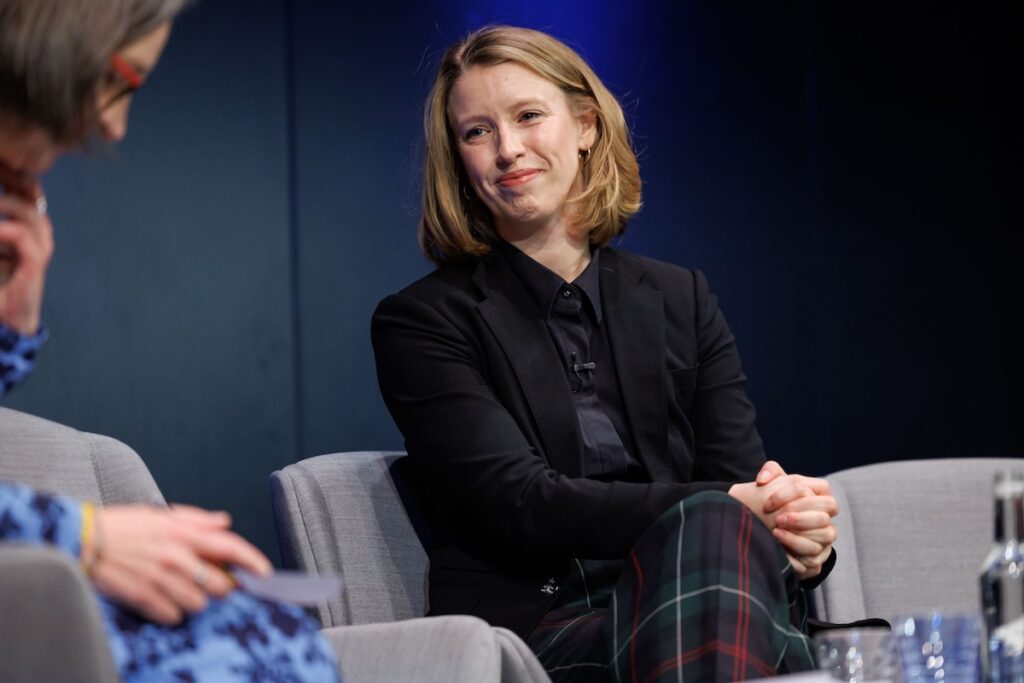
The Scottish Government’s public finance minister said ‘we need to take the public with us on AI’ yesterday at the annual public sector transformation conference – Digital Scotland.
Hannah Mary Goodlad, the MSP for Shetland, said the government needs to communicate the benefits of the technology to an increasingly sceptical public – following recent datacentre protests in Edinburgh.
Ms Goodlad insisted she is ‘wrapping her arms around’ AI datacentre guidance amid a growing backlash from environmental groups as well as opposition from trades unions.
The former oil and gas industry executive, who took her seat in May, said: “When I was standing for election in May, I never thought that I would be a minister straight off the bat. And least of all, I never thought I would be the minister that’s having to wrap my arms around the AI datacentre guidance. But I am, and it’s really important that we have we have leadership on that because AI is developing at such a pace.
She added: “The public are rightfully concerned because there’s an uncertainty about that, and with uncertainty, inevitably comes an element of fear. But it’s really important that government leads with confidence and sees and communicates the benefits of AI in terms of our public services, in terms of innovation, and in terms of [the] health benefits as well.”
Ms Goodlad – who trained as a geologist and worked for the Norwegian majority state-owned energy company, Equinor – talked of the benefits of AI in clinical and diagnostic settings, as well as for a variety of ‘back office’ tasks.
But she said government needs to ‘meet people where they are’ with the technology, not where they would ‘like them to be’.
“People are rightfully concerned, and it’s my job, and it’s my colleagues’ job, and government’s job to communicate clearly the conviction of this government to get this right, [the] conviction of this government to get this right for Scotland,” she said.
She added: “We will do AI, but we will do it in our way, and we will do it in a way that benefits our society, that makes sure that communities that are hosting datacentres benefit from it, and we will do it in a very Scottish way.”
She said: “Scotland is a home of innovation, a home of technology, a home of of many, many digital solutions, and I see the great potential with AI. But I know that I and my colleagues have a leadership role and a communication role to make sure that we take the public with us on this, because there is misinformation out there, and misinformation travels really quickly, and it has created a genuine feeling of concern across the country, and I see that.”
Ms Goodlad referenced the recent 6,000-strong protest in Edinburgh, and said that those concerns and fears need to be “listened to”, and that government take its time to “get it right”.
However, she struck an upbeat and optimistic tone on the role for technology in supporting the government’s public service reform agenda, and spoke of her experience living in Norway, where a national app allows citizens to interact directly with public services.
She said: “In Norway, everything that you experience as a citizen or as a resident of Norway was under that. So if we were driving through a tunnel, and there was a toll on our car, which had a digital sort of tracker on the windscreen, and that bill would come through this platform. If we were accessing our GP or the hospital or some sort of health system, the update and the communication would come through that app.”
She paid tribute to the recently-launched Scottish Government app – mygov.scot – which is building the foundations of a new way for government to communicate with people in Scotland.
Such a ‘one-stop platform’ would help in cutting down on cost and and increasing efficiency across the public sector, she said. But she also warned that life is not experienced in ‘vertical silos’, and that there was a need to ensure – as part of the public service reform agenda – that there is ‘collaboration’ between services.
She said her experience in business allows her to bring a ‘fresh’ perspective to enabling some of those structural reforms, which must go hand in hand with ‘cultural change’.
“Working in Equinor for 15 years, we had seven reorganisations in the time that I was there. So it was almost like an organisational change every two years,” she said. “That’s on one end of the scale and I’m not saying that that’s correct…. but equally, in the private sector, there was no time to develop habits, and I think that’s really important.”