
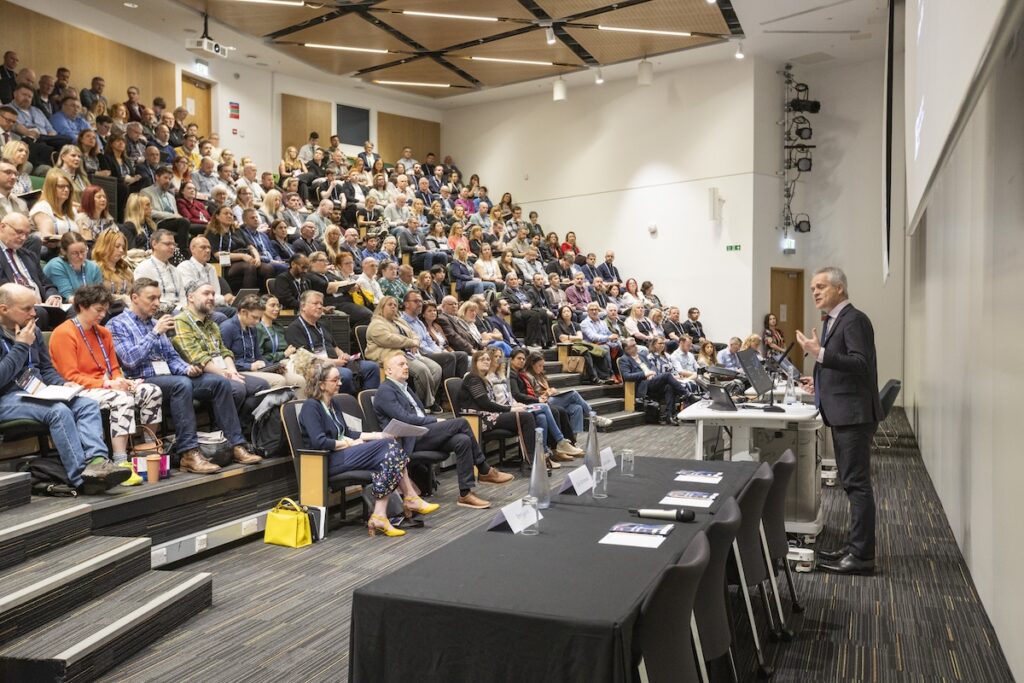
Embracing artificial intelligence as part of an ambitious public sector reform programme represents an opportunity to ‘redesign public services and transform lives for the better’ in Scotland, a top civil servant said yesterday.
AI has the potential to enhance decision-making and make services quicker and more equitable, Colin Cook, director of economic development at the Scottish Government told an audience at Futurescot’s Public Sector AI conference in Glasgow.
Cook, formerly a director of digital, said the technology no doubt poses risks but that we mustn’t shy away from discussing the concerns and ultimately ‘finding a way through’.
And he said Scotland – with its abundance of high quality universities, talent, climate and natural resources – is well-positioned to use the technology to ‘drive responsible and inclusive growth across our economy’.
Cook said: “There’s an opportunity to drive economic success to turbocharge those industries where Scotland is at the forefront, including our AI industry, our digital industry, and more generally, an opportunity to reshape the way that we work with different jobs, high-quality jobs, the ability to remove repetition, improve and augment decision making.
“There is also the opportunity to accelerate our climate and net zero ambitions, and of course, particularly poignant and relevant today, the opportunity to redesign public services, respond to the increasing demands, build personalised services, improve diagnostics, and I hope prevent rather than solve problems, something that has driven the ambition of public service reform since for the last 20 years of the Christie principles.”
The Scottish Government unveiled its new national AI Strategy in March, which outlined a £23 billion economic opportunity for Scotland in the decade ahead.
Cook – whose team developed the 58-page document, which superseded a 2021 version of the strategy, which came before the advent of generative AI – laid out some priority areas for the year ahead.
He described the 10 ‘immediate actions’ for government this year to breathe life into the strategy, the first of which is to set up AI Scotland, a national body to promote AI adoption across the economy. The government will also appoint AI champions in numerous key sectors reporting to an independent expert advisory board.
A nationwide engagement programme will be launched to listen to the concerns of ordinary people. Government will also develop a ‘rigorous, trusted framework’ for AI deployment to ensure safe, ethical, and efficient use of the technology across health and social care services.
A ‘revitalised’ adoption programme will be rolled out to help small businesses take advantage of the technology, and a ‘future jobs panel’ will be established to assess the impact of the technology on the workforce and to ‘co-develop’ solutions with trade unions and to guide national skills planning.
Government will pilot an AI Scale-Up Accelerator, said Cook, to connect high-growth companies with experienced entrepreneurs and investment networks, and launch an innovation programme that applies commercial and research expertise in AI to the delivery of public services.
It will also work with key partners to promote Scotland as a destination for ‘green data centres’ and to maximise the opportunity from the recently announced AI Growth Zone in Lanarkshire. DataVita, the Glasgow-based datacentre provider, in partnership with CoreWeave, are delivering a £1.5 billion investment in renewable-powered AI infrastructure in the region.
Cook also spoke of a ‘data matchmaking pilot’ enabling organisations to ‘access trusted, protected and secure’ public sector datasets in order to support data-driven innovation.
And he spoke about working collectively to achieve all those aims.
“The decisions need to involve everybody. They’re not going to be taken by two or three people working in a university or in any part of government either – they’re going to be taken by the people who design public services, who deliver public services, who use public services, and who rely on public services, but we can do this,” said Cook.
He added: “We can deliver a country where AI transforms lives for the better, where decision-making is augmented, where services are quicker and then more equitable. We can deliver a country where…the triple helix spins and spins, where businesses and universities and the public sector are working together in collaboration to identify the key problems we need to face, find the solutions, and turn those into commercial opportunities.”