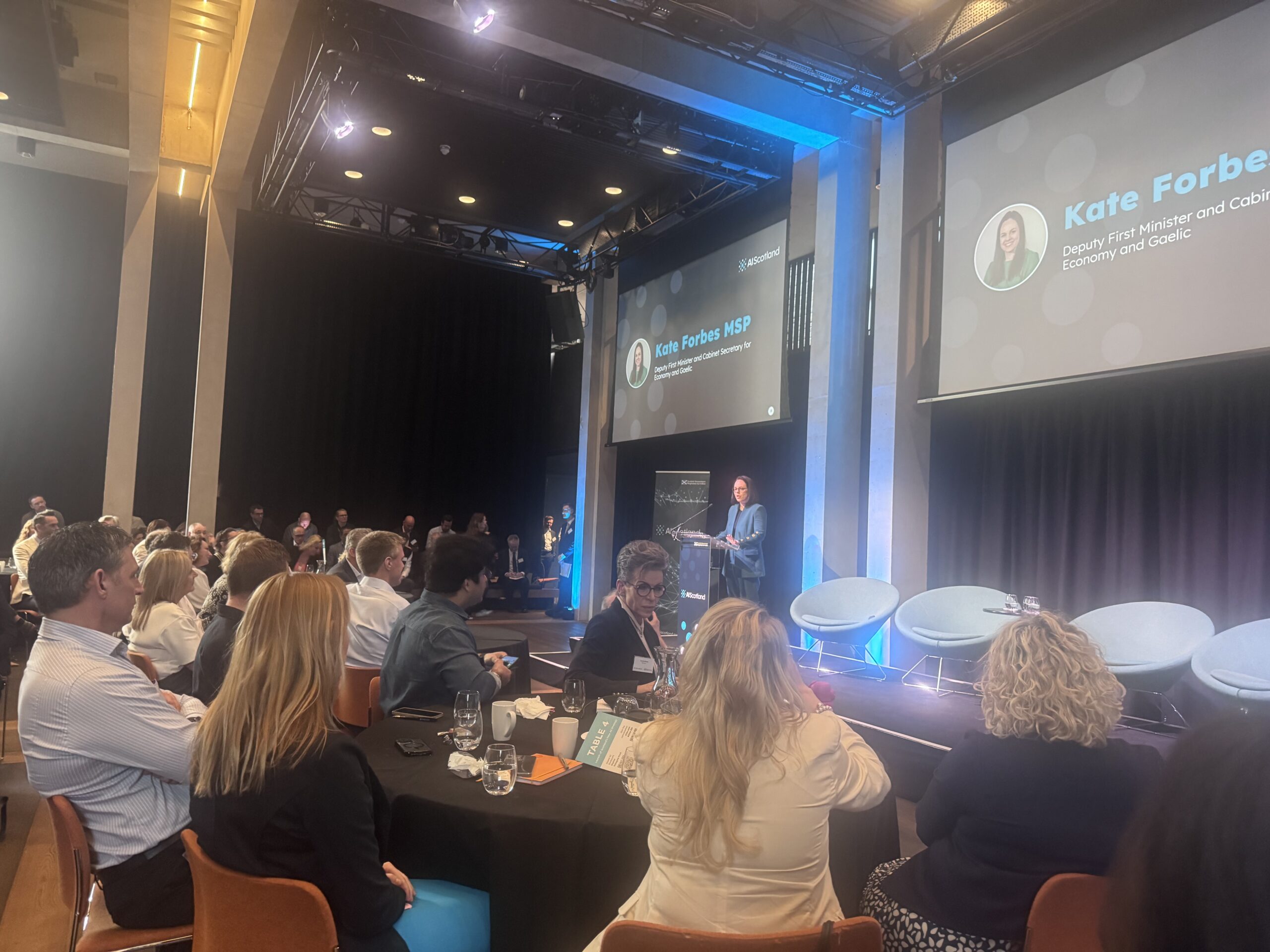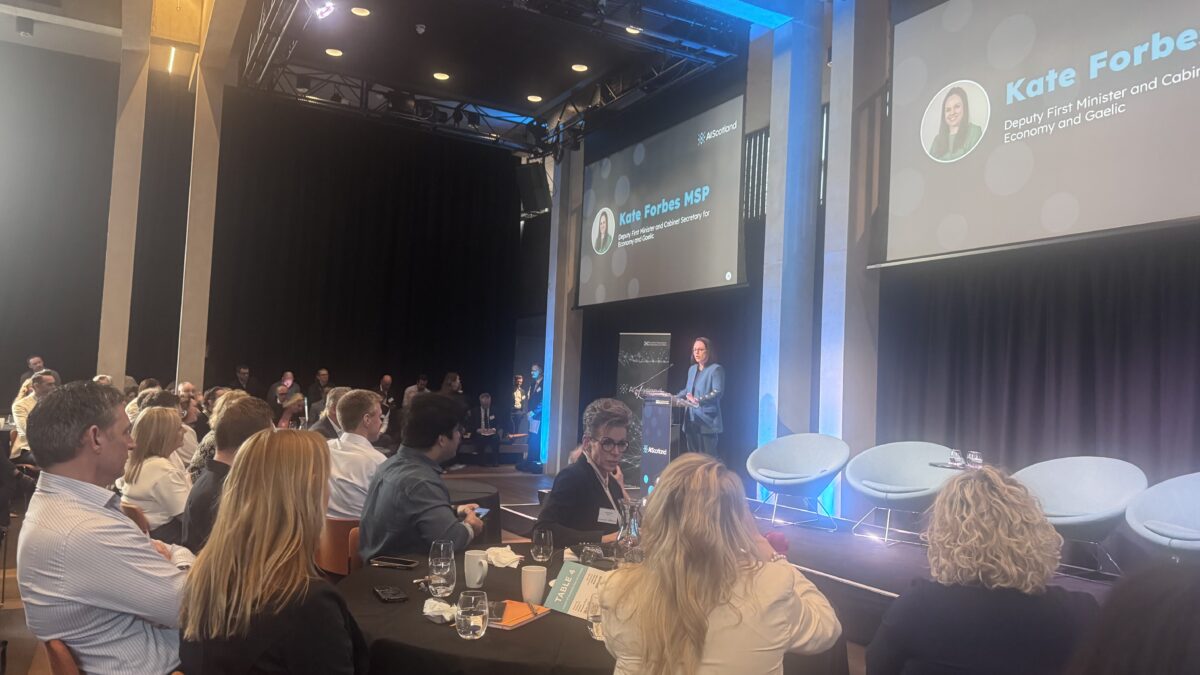

Artificial intelligence is the ‘next major frontier’ and could add £23 billion to Scotland’s economy by 2035, a Scottish Government minister said today at the launch of a new national AI strategy in Edinburgh.
Business minister Richard Lochhead said there are now 300 AI-focused companies operating in Scotland, and name-checked one AI firm that is now officially Scotland’s fastest-growing company, having grown from zero to $100million in 18 months.
Wordsmith AI, singled out by Mr Lochhead, is focused on the legal sector, but is testament to the huge growth potential for the technology and Scotland’s rich ecosystem for AI development.
Scotland is leading AI adoption in the public sector as well, said Mr Lochhead, with a third of local authorities now exploring using the technology for frontline services. However the unveiling of the new strategy was marred by Edinburgh City Council’s backing of a motion last night to put a temporary ban on data centres developments over environmental concerns.
Mr Lochhead said: “AI represents one of the greatest and economic and social transformations of our time. It’s going to help save lives. It’s going to reform our public services. It’s going to create thousands of new, highly paid jobs in our country. It’s going to help create new startups. It’s going to help startups to scale up, which is a big challenge for Scotland as well.
” It’s going to help bring economic growth, improve our quality of life. It’s going to help maintain Scotland’s reputation to lead the world when it comes to science and tech as well. It’s going to build in the legacy that we have that’s been there for decades.”
But he also warned of the disruption caused by AI.
He said: “We have to act quickly as a country to identify and support those most likely to be at risk by investing in new skills to protect jobs and ensure those who are able to grasp the opportunities that AI creates are there to do that.
”We know that AI can potentially deepen inequalities, if it’s not developed and deployed responsibly [and] in Scotland we have a commitment for fair work, and that has to be reflected in the policy going forward.”
He also reflected on the ‘great advantages’ of Scotland’s cool climate for situating energy intensive AI data centres, but the country benefits from publicly-owned water industry, and abundant renewable energy.
The launch of the strategy took place at the Edinburgh Futures Institute and featured a panel discussion involving business, policy, academic and public sector leaders.
Albert King, chief data officer at NHS National Services Scotland, said introducing AI to the NHS was a complex process, with many checks and balances over data protection, and regulatory requirements.
However, he said there was now a need to improve services and that the public would not tolerate the NHS failing to secure the benefits of improved healthcare through AI.
“Because ultimately, populations, our public services are crying out for improvement, and it’s not good enough to sit on our hands and not to deliver that,” he said.
Recognising that the human element had to be kept in view, King added: “And you know, it’s important, obviously, that we move with care, but it’s important that we also move at pace, so that we do secure these benefits.”
He added there was a real opportunity for deeper collaboration between the NHS and industry, and ‘narrowing the gap’ between innovators and public services.
At the same time emphasising the need for good stewardship over NHS data, he said: “There’s some unglamorous stuff we need to do to make it easier to get some of those fantastic innovations from the SMEs that are some of them are delivering really great solutions. I see them every day and it’s about how do we get those actually into our public services.”
In terms of barriers to adoption of AI, the panel addressed the issue of having ‘more AI pilots than Heathrow’.
David Tuck, CEO of Waracle, said often the biggest barrier was a failure at the top of organisations to understand the technology.
He said: “ I speak with a lot of business leaders, particularly outside of technology, and there’s a fear of getting started as individuals using AI in leading organisations across different industries, and that fear is one of worry about confidentiality, security and also just getting it wrong.
“And so the first thing that we often do is help [people] to understand and learn how to use AI in a way that is is right for them.”
He added: ”Organisations can’t elevate their people with AI and get the benefits of both productivity and value from AI, if at the very top there’s not an understanding of this technology, an understanding of how to use it themselves.”
Tuck conceded that Scotland is unlikely to be able to compete with the huge US tech companies including Google Gemini and Anthropic, but he said: “We have to take advantage of those technologies and make sure we’re creating our own our own success stories, too.”
Scotland’s AI Strategy sets out a five-year plan to ensure ‘people, businesses and public services across the country benefit from AI.’ First published in 2021, with a focus on harnessing AI that is ‘inclusive, ethical and trustworthy’, but before the likes of large language models (LLMs) became ubiquitous tools, the updated strategy pushes Scotland into a new era for AI, with a more business-like focus on the technology.
Initiatives to be implemented in the first year of the strategy include:
- Establishing an independent expert advisory board to provide strategic guidance on the strategy’s delivery
- appointing AI Champions to represent priority sectors and regions
- rolling out an expanded AI adoption programme for businesses to help drive productivity and competitiveness across the economy
- creating a Future Jobs Panel to assess AI’s impact on the workforce and establishing an AI Leadership Academy established
A new body – AI Scotland – has also been set up to foster economic development for the technology across Scotland.
Deputy First Minister Kate Forbes said: “The unprecedented pace at which AI is increasing and evolving presents an enormous opportunity. It has the potential to be genuinely transformative – for every sector of our economy, and for people from all backgrounds and communities.
“This strategy sets out a clear plan to harness the economic and social benefits of AI responsibly with practical, tangible steps to be taken this year to help ensure we translate our innovation and expertise into more businesses, jobs and investment.
“In establishing AI Scotland we will use the expertise of our enterprise agencies, The Data Lab and other partners to lead an accelerated, co-ordinated approach to ensure Scotland’s economy and society reaps the rewards of this incredible technology.”