
The UK’s national supercomputer – hosted at the University of Edinburgh – has delivered a £4.2 billion boost to the UK economy over five years, new research has shown.
ARCHER2, located at the Edinburgh Parallel Computing Centre (EPCC), has generated an equivalent to a return of £8.30 for every £1 of public funding, according to an independent report by London Economics.
The vast majority of the economic benefits, worth an estimated £3.7 billion, were attributed to academic research and development (R&D), with £517 million from the formation of spin-out companies, new products and services, and skills.
ARCHER2 enables complex modelling that would otherwise be impossible to study using experiments. These include simulations of climate change impacts, how well new drugs might work and the performance of jet engines.
The report was commissioned by UK Research and Innovation (UKRI), and details the scientific impacts of ARCHER2.
The analysis identified more than 2,100 publications, spanning 20 different fields of research, that were enabled through the use of ARCHER2. In total, the publications involved researchers from more than 1,100 different institutions in 88 countries.
ARCHER2 was funded by the Engineering and Physical Sciences Research Council (EPSRC) and Natural Environment Research Council (NERC), both part of UKRI.
Jane Nicholson, executive director for research at EPSRC, said: “This independent evaluation demonstrates the excellent value that ARCHER2 has delivered for UK research and innovation since its launch in 2021.
“A return of £8.30 for every £1 of public funding invested is a positive result, but what truly brings these figures to life are the real-world breakthroughs this supercomputer has enabled.
“From advancing treatments for heart disease and tackling antibiotic resistance, to accelerating the development of cleaner aircraft as well as understanding and addressing climate change. These outcomes from ARCHER2 usage clearly demonstrate the contribution that access to supercomputing makes both for science and for society as a whole.”
Professor Mark Parsons, director of EPCC and dean of research computing at the University of Edinburgh, said: “This report provides a resounding justification of the value of Government investment in large-scale national supercomputing. EPCC works very hard to deliver an excellent service for our users. This report shows how our users repay our efforts by delivering world-class research and real value to the UK economy.”
The analysis of ARCHER2’s economic and scientific impact follows the announcement in June 2025 that the UK’s next national supercomputer will also located at EPCC at the University of Edinburgh, backed by up to £750 million in funding.
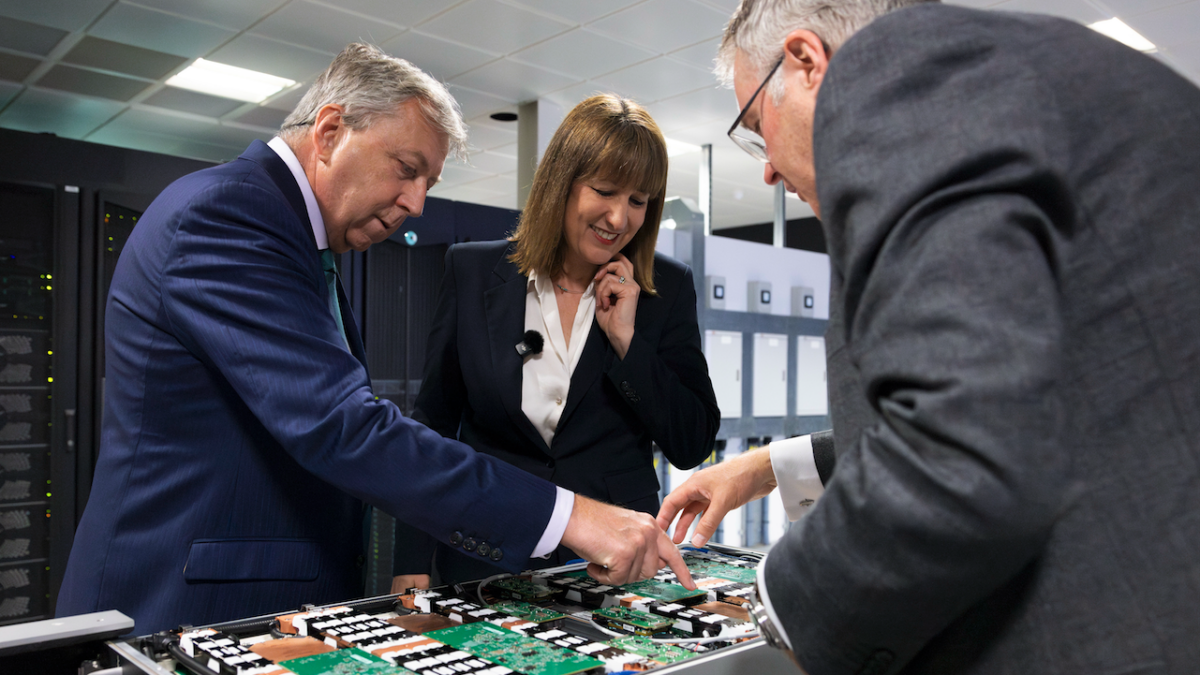
Chancellor Rachel Reeves visited the Easter Bush facility the following month to mark launch of the UK Government’s Compute Roadmap, which set out the long-term plan to expand computing infrastructure and position the country as a global leader in artificial intelligence and scientific innovation.
As part of the Compute Roadmap, EPCC at the University was named as the first in a new network of National Supercomputing Centres that will be set up in locations across the UK.