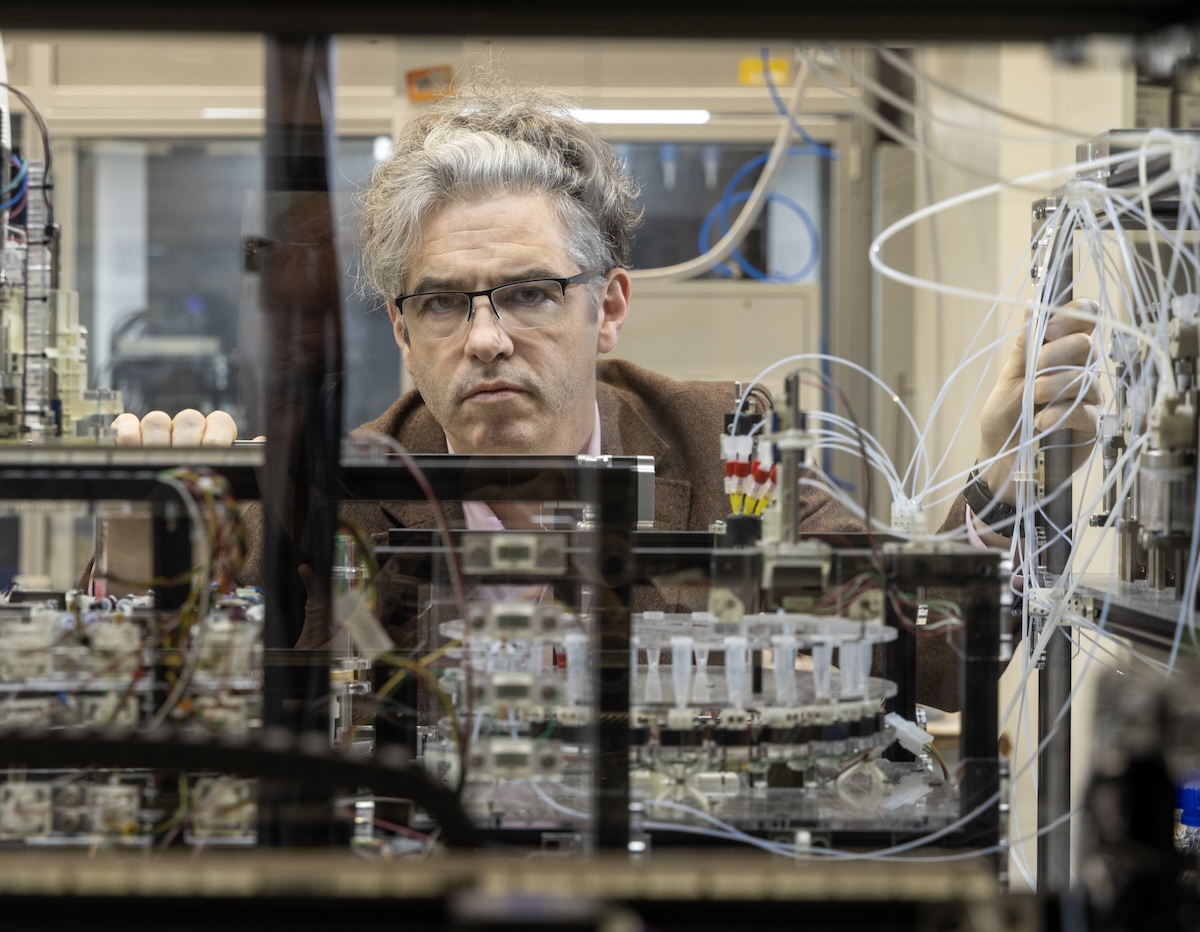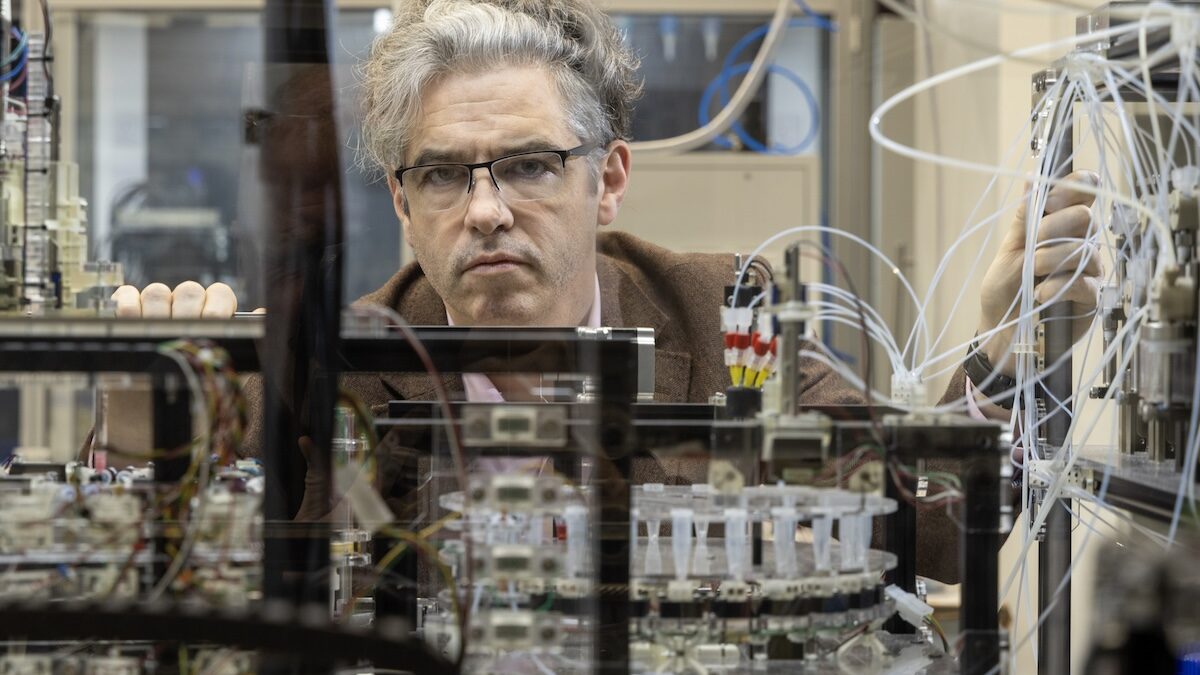

An AI-powered chemistry technique born in Glasgow has been ‘validated’ by three leading journals – potentially heralding a new dawn for drug discovery including cancer research.
The ‘Chemputation’ method developed by startup Chemify could become a new paradigm for how small molecule-drugs and materials are discovered, designed and manufactured.
Devised by Professor Lee Cronin, the Regius Professor of Chemistry at the University of Glasgow, the chemputer uses complex algorithms to automate the process of creating molecules used as compounds for new medications.
The ‘robotic synthesis’ method is outlined in three new peer-reviewed papers: PNAS, Nature Communications Chemistry and Nature Communications Biology.
They describe how the Chemputation AI platform can understand and execute instructions to make new molecules from scientific literature, produce them iteratively and how this could be applied to cancer research.
Together, the papers demonstrate the potential of Chemputation to digitise chemistry and become the foundation for the autonomous discovery, manufacturing and generation of high-value molecules at scale.
“Chemputation has been established as a new paradigm, critical for the future of chemical discovery and manufacture, and I’m proud that Chemify is building on these discoveries delivering real molecules using Chemputation AI to our partners,” said Cronin, CEO and founder of Chemify.
“Chemputation shifts chemistry from an artisanal practice to an executable, verifiable and shareable technology and opens the door to a future where drugs, materials and entirely new and makeable molecules can be designed, compiled and manufactured as easily as software.”
The three papers were all published within the last two weeks by Lee Cronin and multidisciplinary co-authors from the University of Glasgow, where Cronin has a lab.
- The Proceedings of the National Academy of Sciences publication from April 7, “Chemputer and chemputation—A universal chemical compound Synthesis Machine,” discusses a new proof that chemical molecules can be made using the chemputation process, opening the way to use one simple programming language to make molecules.
- The Nature Communications Chemistry publication from April 3, “Verification and execution of the scientific literature via chemputation augmented by large language models,” describes how a system of agents is used to both read and correct the chemical literature so that the procedures can be safely used by robots capable of Chemputation to autonomously make the molecules and verify the process.
- The Nature Communications Biology publication from March 27, “Chemical programming of kinase inhibitors in a modular chemputer-based system,” shows how the Chemputation system can be used to iterate on new potential cancer treatments based on targeting a model of KRAS-mutant colorectal cancer in a practical example of how Chemputation is being applied to address challenges in preclinical drug discovery.
Chemify was founded in 2022 as a spin-out from the University of Glasgow, and closed a $50 million Series B financing co-led by Wing Venture Capital and Insight Partners in October of 2025. Chemify opened its first Chemifarm in June of 2025 to revolutionize molecular design and manufacturing, and has a variety of active small molecule research collaborations with multiple biotech, pharmaceutical and institutional partners.