New analysis has shown that artificial intelligence deployment in the public sector could help slash administration time by over a third in Scotland.
So-called ‘repeatable’ office tasks such as documentation, record keeping, triage, correspondence and case preparation could be reduced by up to 35 per cent through the ‘safe and well governed use of AI’.
Edinburgh digital tech consultancy Storm ID, which has launched a new public sector-focused white paper on AI and automation, calculates that there are currently 178 million hours spent on such tasks, with most in the NHS or in education.
AI-enabled redesign could materially support in-service pressure, including off-setting projected growth in demand and administrative load, the company’s research shows.
The paper, ‘Automate tasks, not jobs: The AI opportunity for Scotland’s public services’, forecast its AI-related time savings with the explicit aim of protecting frontline capacity rather than cutting roles.
The additional capacity returned to frontline services – including the NHS – would help improve throughput, reduce backlogs, and increase time for higher value work.
Paul McGinness, Founder and Chair of Storm ID, said: “Scotland’s public services don’t just have a funding problem; they have a capacity problem. Highly skilled professionals are spending too much time on administrative work that technology can now help with.”
“This is about automating tasks, not jobs. In a system under real workforce strain, AI should be used to support staff, not replace them.”
He added: “If we do this properly, the prize isn’t abstract efficiency. It’s shorter waits, better decisions, improved citizen and staff experience and more time for frontline care and teaching.
“The opportunity now is to move beyond pilots and proofs of concept, and focus on shared, reusable solutions that can scale safely across Scotland’s public services.”
The analysis looked at the top 50 high-priority services based on their high volume (in terms of hours), high AI potential and data availability, defined as ‘services with robust published statistics for accurate baselining’.
Collectively, these 50 services represent a baseline of 177.8 million hours of work. The opportunity is distributed across five key sectors:
- NHS Scotland: The largest opportunity, with 80.2m baseline hours and potential annual savings of 7.3m – 27.1m hours.
- Education: 36.6m baseline hours (potential savings: 3.7m – 13.9m hours).
- Local Government: 31.5m baseline hours (potential savings: 2.9m – 10.8m hours).
- Policing & Justice: 21.1m baseline hours (potential savings: 1.9m – 7.0m hours).
- Other Public Bodies 8.4m baseline hours (potential savings: 0.8m – 3.2m hours).
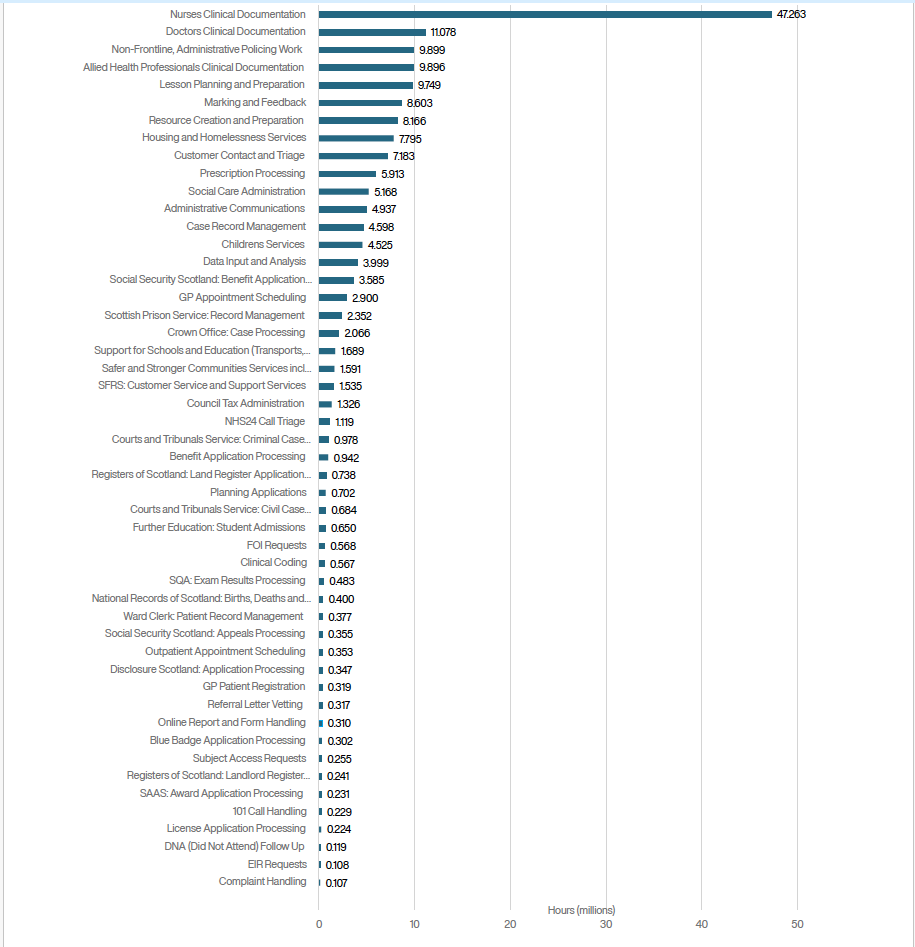
The report also looked at low, moderate and optimistic AI adoption scenarios and weighted the estimated time savings accordingly.
The white paper suggests that despite the diversity in the nature of the work undertaken by many public services, the underlying operational workflows are not. The majority of staff time clusters into a small number of repeatable service patterns:
- Scheduling, capacity and follow-up orchestration
- Case and record lifecycle management
- Application processing and eligibility/decision-making
- Knowledge-intensive documentation
- First contact, triage and routing
The research argues that shared, reusable AI components, aligned to these common patterns and integrated into existing systems of record, would be the best strategic approach to adoption.
The firm therefore points to five priority recommendations:
- Start where value can be demonstrated quickly
Prioritise high-volume, lower-risk services to build confidence and institutional capability. - Build once, reuse many times
Develop shared AI components aligned to common service patterns, avoiding duplication across organisations. - Put governance front and centre
Establish clear accountability, auditability, cyber controls, testing and defined human oversight consistent with Scotland’s commitment to trustworthy and inclusive AI. - Adopt a mixed infrastructure model
Combine UK public cloud for suitable workloads with private AI infrastructure for high-sensitivity services. - Treat workforce enablement as a core deliverable
Embed training, role redesign and staff engagement from the outset
The research relied on publicly available datasets, including the ONS Public Sector Time Use Survey (2024), with each task scored using the Alan Turing Institute exposure rubric (2024).