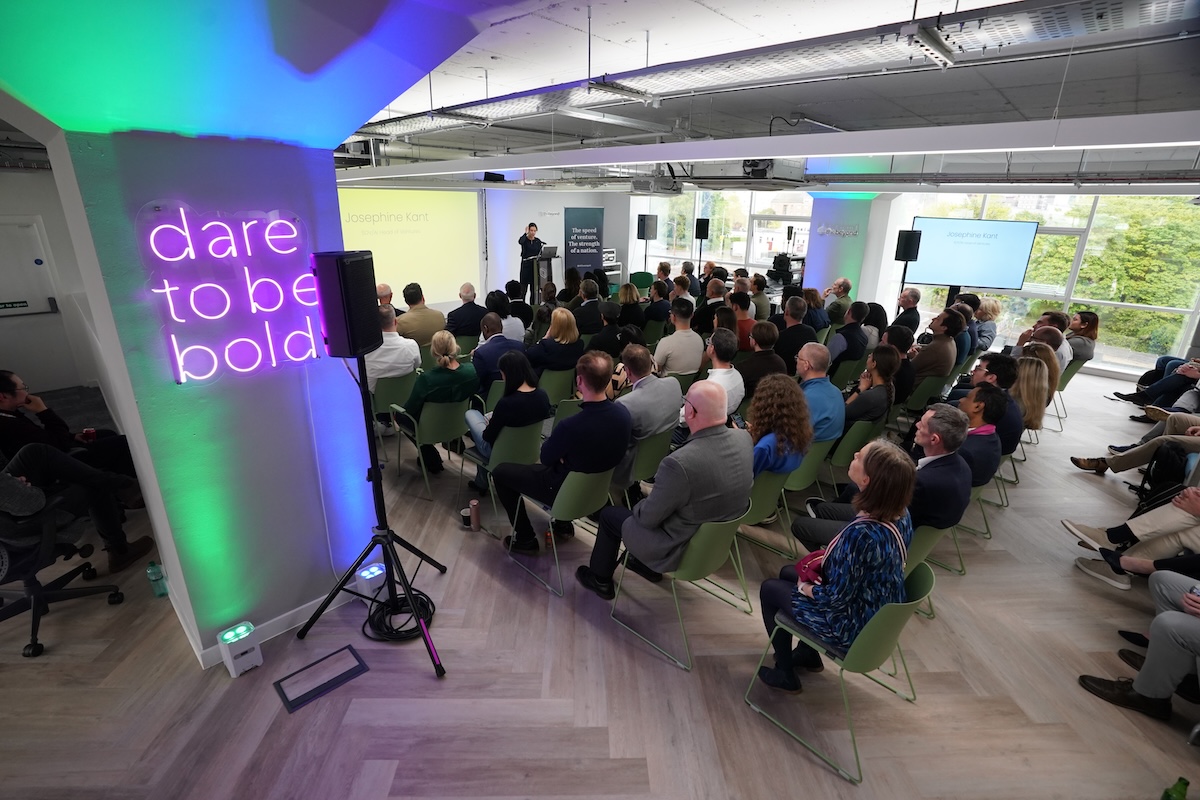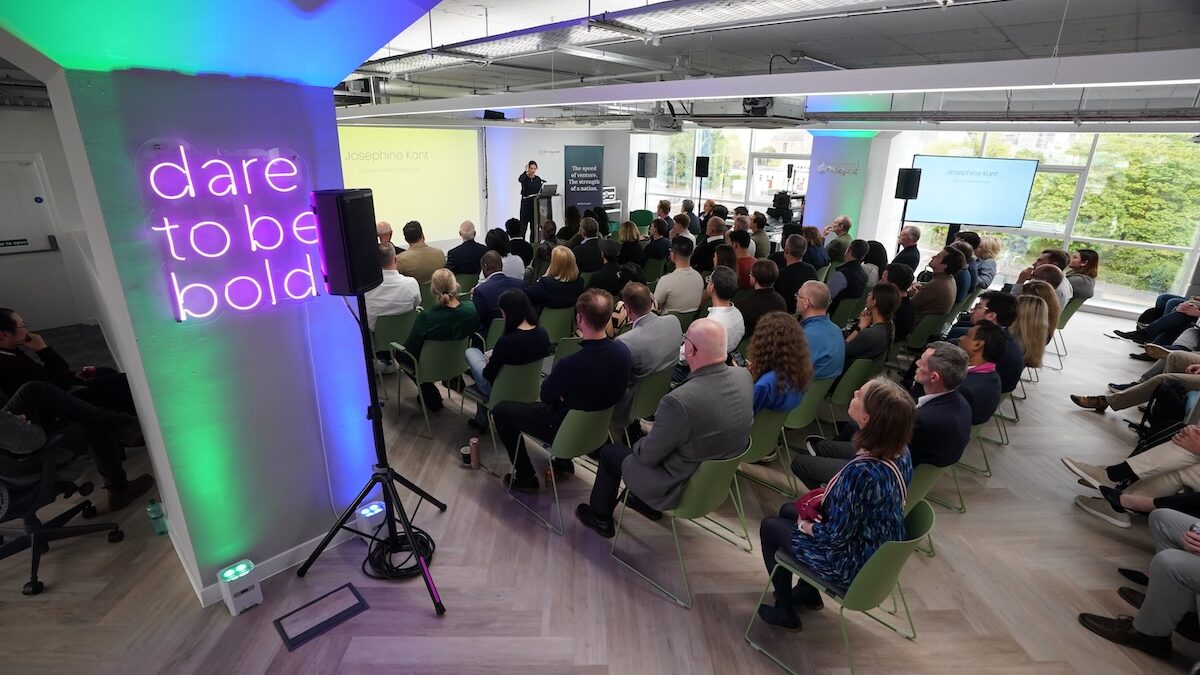

The UK Government unveiled its £500 million sovereign AI investment fund in Glasgow last night – in a bid to encourage Scottish AI companies to apply for growth funding.
Civil servants visited ‘the beyond’ at the city’s Skypark – a co-location hub for nascent technology businesses – to formally announce the Scottish launch of the national SOV/AI venture fund.
Designed to support export-ready, scaling AI firms, the fund is available to high-growth potential businesses in emerging AI fields, including embodied AI, which brings the technology into the heart of physical systems, such as humanoid robots, autonomous vehicles and drones.
Josephine Kant, head of ventures at Sovereign AI, a part of the Department for Science, Innovation and Technology (DSIT), said: “Our purpose is not just to fund startups. It is to make sure that the companies that matter most strategically to this country get built here, scale here, and are anchored here.
“We invest directly, founder first, at the pace of venture, we make high conviction bets on technically exceptional teams, and we just heard eight of these teams pitch earlier today. And we very much [offer] things that no traditional VC [venture capitalist] can offer, from access to our supercomputers, to R&D funding for strategic assets, which I encourage some of you to apply for just now, to talent and visa pathways and procurement routes to actually get government as an early customer.”
Kant stressed that the government-backed fund, which will be distributed over the next four years, will not replace private capital, but instead will work to ‘unlock it’. She said however that you cannot ‘announce sovereign AI into existence’, and that the capabilities are built over decades with research institutes and universities leading the charge.
That positions Scotland well, she said, to capitalise on the extraordinary institutional capabilities spanning quantum, photonics and nanofabrication that are driving the world’s most advanced technologies.
In that regard, she name-checked Glasgow University’s James Watt Nanofabrication Centre and the University of Edinburgh – a top-ranked university for computer science research. Kant also credited Scotland’s cutting-edge capabilities in drug discovery, financial services, robotics, telecoms, as well as the more recent AI Growth Zone in Lanarkshire, where data centre infrastructure is being built out to support growth in AI for Scotland and the UK.
She added: “When you’re walking through the door at any of these places, including the beyond, you’re not walking into a project, right? You’re walking into the compound interest of a very long, deliberate national effort, and that to me is sovereign capability. And Scotland has more of it than almost anywhere in Europe, and you can see that in the numbers, this is not a country that is waiting to be told what to do with this technology.”
Kant acknowledged that although the first three investments have been in London-headquartered AI startups, the intention is to widen that out across the UK.
“That reflects where deal flow reached us in the first few weeks after launch, not where we think that the next decade of British AI companies will be built,” she insisted.
She added: “Our mandate is UK-wide. We have a really strong pipeline of activity from Scotland, and a lot more companies just got added to that tonight, as well as the North of England and Wales. And our next investments will be where the best founders are, and we all believe that a great many of them are here.”
Kant and her colleague Will Bushby were welcomed to the beyond – the home of the Smart Things Accelerator Centre (STAC) – by its founder, Paul Wilson.
Wilson, who has been instrumental in building a smart technologies hub in Glasgow, backed by private capital, with the launch of a recent ‘Deep Tech Fund’, said: “STAC, even within 18 months, has developed five corporate partners who really want access to the innovation.
“We are just about to announce another three, and by probably Q3 we will have 10 corporate partners, so we will work with them. We will be that bridge, we will understand their pain points and opportunities, and we will translate that to technology. We will find it within our cohorts, and if they’re not there, you’ll go and source it in the finest universities in the world, and then we’ll connect it up, and we’ll take it to scale.”