


A group of Glasgow researchers used off-the-shelf mobile connectivity hardware to engineer a new approach to remote, robotic surgery.
Scientists from the University of Glasgow’s James Watt School of Engineering were able to build a 4G LTE mobile network using cheap components, which could help doctors operate on patients from afar.
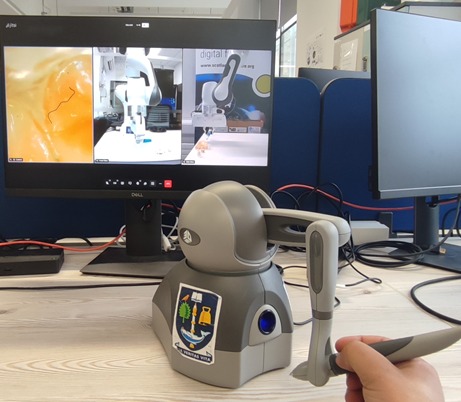
The researchers used the mobile network to connect a haptic controller to a robotic arm, which in the future could be used for remote surgery.
The team’s system is built using the Open Radio Access Network (O-RAN) framework, which uses open-source software to control mobile network hardware.
They repurposed a USB network dongle, more commonly used for consumer mobile internet, to create stable connections between the haptic input device, the robotic arm, and a computer configured to act as an intelligent base station.
Using specialised software called xApps, they could monitor and fine-tune the performance of the system’s signal quality, data rates and latency.
In their lab tests, the team were able to enable communications between the base station, the controller and the robotic arm with a bandwidth of 10Mbps. The high-quality connection allowed them to control the arm to simulate a dental exam on dentures with less than a second of latency and minimal signal loss, according to a new paper published in journal Communications Engineering.
Professor Muhammad Imran, head of the James Watt School of Engineering and the paper’s lead author, said: “The Internet of Skills is now one step closer with the advent of low-latency, high-reliability communication links. With Open RAN (O-RAN) making these technologies more affordable and accessible, I’m proud that our team is helping to lay the foundation for truly inclusive digital accessibility for all.”


