

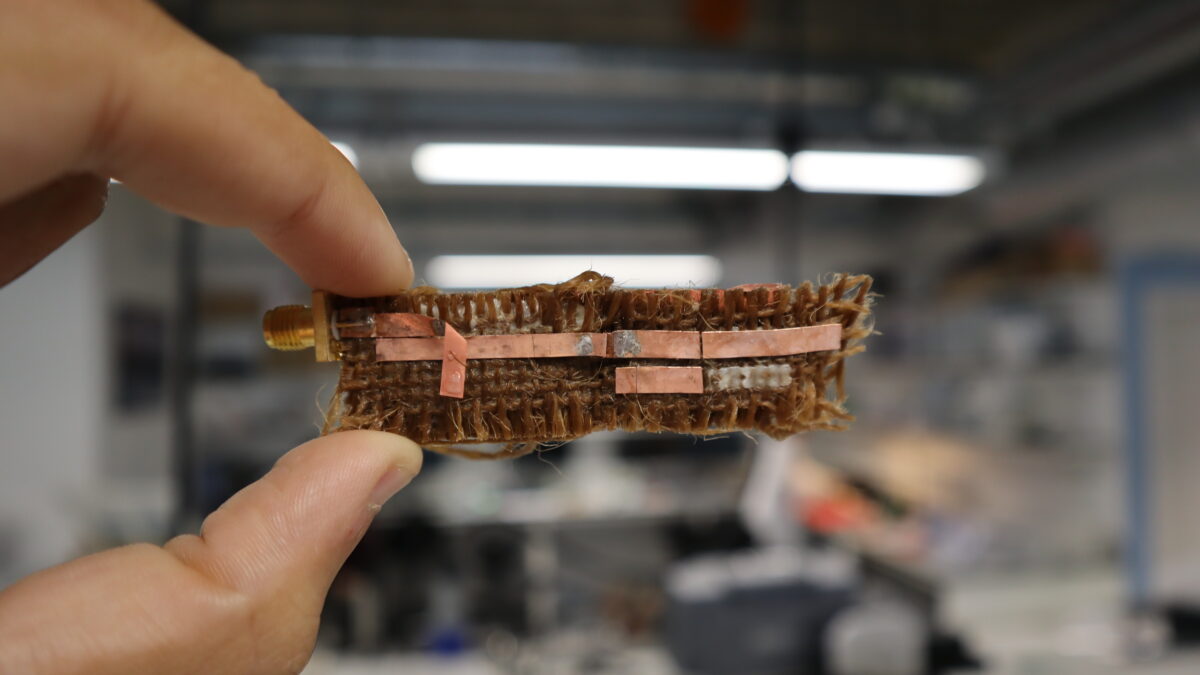

Researchers at the University of Glasgow are pioneering biodegradable circuit boards that can be degraded in hot water at the end of their life to drive a greener future for wireless communications.
The partnership between the university and Jiva Materials aims to cut down on the electronic waste produced by traditional printed circuit boards, or PCBs.
PCBs account for up to 40% of the world’s waste electrical and electronic equipment. Conventional PCBs, which use flame-retardant composites or ceramics, are impossible to recycle and are sent to landfill.
More advanced circuits often contain ‘forever chemicals’ like PFAs, which cause harm to the environment, humans and animals when they leach into groundwater.
To help tackle the issue, Jiva Materials have developed Soluboard, a biodegradable circuit board made from natural fibres such as jute and flax, coated with a water-soluble resin.
At the end of their lifespan, the boards can be degraded in hot water, while their copper tracks and integrated circuit chips delaminate and can be subsequently recycled.
Researchers from the University’s James Watt School of Engineering are working with JIVA Materials to unlock the full potential of the Soluboards for use in high-speed electronics operating at GHz frequencies.
In the future, those greener PCBs could enable sustainable wireless devices for use in Internet of Things sensors and consumer electronic devices.
In a new white paper published on the University’s website, the partners demonstrate how Soluboards can be used for radio frequency applications. They show that the PCBs can transmit signals at frequencies exceeding 4 GHz, which covers common wireless applications such as Wi-Fi, Bluetooth, and RFID.
The paper also shows how Soluboards can support high-speed signals exceeding 3 gigabits per second without any distortion, a range which could allow mainstream consumer electronics with interfaces such as HDMI and USB.
Dr Mahmoud Wagih, reader at the University of Glasgow’s James Watt School of Engineering, is the project’s lead. He said: “We’re pleased to be working with Jiva Materials on this project, which could have a major impact on reducing the carbon footprint of the electronics industry. Moving towards more sustainable, recyclable electronics is vitally important to help reduce the impact of our technology sector, particularly with the rise of single-use devices across the industry.
“Working with natural and plant-based circuit materials is inherently challenging, particularly in wireless applications for RF and microwave applications. Together with our partners at JIVA Materials, we are developing new designs which improve the circuits’ efficiency, accelerating the adoption of green PCBs.
“The way forward is to co-design the materials with the specifications for meeting the wireless RF specifications, coming up with antenna and radio designs which meet the size and performance requirements of end users, particularly in consumer applications.”


